
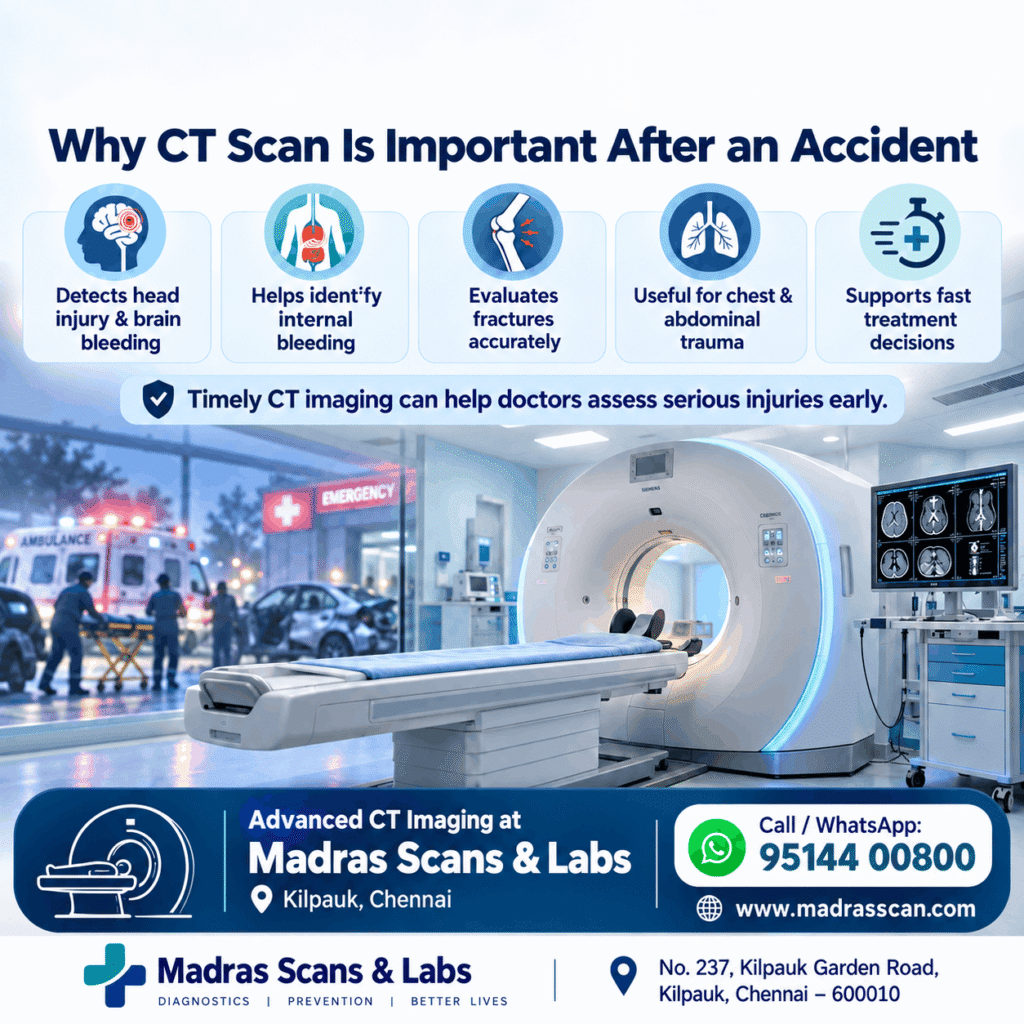
Early Detection of Internal Injuries, Brain Bleeding and Fractures Can Help Doctors Make Timely Treatment Decisions
Road traffic accidents can result in injuries ranging from minor bruises to serious internal damage. While some injuries are immediately visible, others may remain hidden during the initial examination. A person involved in a road accident may appear relatively normal despite having injuries that require urgent medical attention.
This is where a CT Scan in Chennai plays an important role in evaluating accident-related injuries.
Computed Tomography (CT) is an advanced diagnostic imaging technique that produces detailed images of the brain, bones, chest, abdomen, pelvis and other internal structures. When clinically indicated, CT imaging helps doctors identify injuries, assess their severity and plan appropriate treatment.
At Madras Scans & Labs, Kilpauk, Chennai, advanced CT imaging services support the diagnosis of accident-related injuries and other medical conditions.
Why Is a CT Scan Important After an Accident?
An accident can cause considerable damage to internal organs even when there are no major external wounds.
CT scanning can help identify potentially serious conditions such as:
Bleeding inside the brain
Skull and facial bone fractures
Injuries to the cervical spine and vertebral column
Internal bleeding within the chest or abdomen
Lung injuries and collapsed lungs
Liver, spleen and kidney injuries
Pelvic and complex bone fractures
Injuries involving major blood vessels
CT imaging provides detailed cross-sectional views, helping doctors understand the location and extent of suspected injuries.
However, not every accident victim requires a CT scan. The decision depends on the mechanism of injury, symptoms, physical examination and the treating doctor’s clinical assessment.
1. CT Brain Scan After a Road Accident
Head injuries are among the most concerning consequences of road traffic accidents, particularly motorcycle accidents, falls and collisions involving significant impact.
A head injury may cause bleeding inside the skull, swelling of the brain or fractures of the skull bones.
When might a CT Brain Scan be recommended?
Doctors may recommend a CT Brain Scan when an accident patient develops:
Loss of consciousness
Repeated vomiting
Severe or worsening headache
Confusion or abnormal behaviour
Seizures following an injury
Weakness of the arms or legs
Suspected skull fracture
Other concerning neurological symptoms
A CT Brain Scan in Chennai can help identify acute intracranial bleeding, certain brain injuries and skull fractures.
For suspected acute head trauma, a CT brain examination without contrast is commonly the preferred initial imaging investigation when imaging is indicated.
Prompt diagnosis enables the treating medical team to decide whether observation, further imaging, intensive monitoring or urgent specialist treatment is necessary.
2. CT Spine Scan for Neck and Back Injuries
The sudden impact of a vehicle collision may cause injuries to the cervical, thoracic or lumbar spine.
These injuries can involve vertebral fractures or displacement and may sometimes be associated with damage to the spinal cord.
A CT Spine Scan can help doctors assess:
Fractures of the vertebrae
Spinal alignment
Complex bony injuries
Injuries involving the posterior elements of the spine
Fractures that may be difficult to assess on conventional X-rays
CT is particularly useful for evaluating the bony structures of the spine, while MRI may be needed when spinal cord, ligament or other soft-tissue injuries are suspected.
Important: A person with a suspected spinal injury should not be moved unnecessarily. Appropriate spinal precautions must be maintained until the medical team determines it is safe.
3. CT Chest Scan to Detect Injuries Inside the Chest
A road accident can cause injury to the chest due to impact against the steering wheel, seat belt, vehicle body or road surface.
Some potentially serious chest injuries are not obvious from the outside.
A CT Chest Scan can help detect:
Rib and sternal fractures
Lung contusions
Pneumothorax (air around the lung)
Haemothorax (blood around the lung)
Certain injuries to the major blood vessels
Other traumatic injuries within the chest
Depending on the suspected injury, the doctor may recommend contrast-enhanced CT or CT angiography.
Detailed CT imaging can help the treating team identify injuries that require monitoring, intervention or surgical assessment.
4. CT Abdomen and Pelvis for Internal Bleeding
One of the major concerns following significant blunt abdominal trauma is internal bleeding.
Unlike external bleeding, internal bleeding may not be immediately visible. Some patients may initially have relatively mild symptoms despite significant injury.
A CT Abdomen and Pelvis Scan can help evaluate:
Liver injuries
Splenic injuries
Kidney injuries
Blood collection within the abdomen
Injuries involving abdominal blood vessels
Pelvic fractures
Certain bowel and mesenteric injuries
In a haemodynamically stable patient with suspected significant abdominal injury, a contrast-enhanced CT scan is often an appropriate investigation.
Patients who are unstable require immediate emergency assessment and resuscitation. CT should not delay lifesaving treatment.
5. CT Scan for Complex Bone Fractures
Although X-rays are the first investigation for many fractures, complex fractures may require additional imaging.
CT is particularly helpful when doctors need more detailed information about:
Pelvic fractures
Acetabular fractures involving the hip socket
Complex shoulder fractures
Fractures extending into joints
Multiple bone fragments
Complex facial fractures
Modern CT imaging allows multiplanar and, when needed, three-dimensional reconstruction of bones.
These images can help orthopaedic surgeons understand the fracture pattern and plan appropriate management.
6. Whole-Body CT Scan in Major Accidents
In selected patients with severe or multiple injuries, doctors may recommend a whole-body CT examination, sometimes referred to as a trauma CT or pan-scan.
This approach can assess several anatomical regions during a coordinated imaging examination.
Whole-body CT may be considered following high-impact accidents when multiple serious injuries are suspected.
However, it is not necessary for every accident patient. The decision depends on the patient’s clinical condition, stability and the trauma team’s assessment.
CT Scan Versus X-Ray After an Accident
Both CT scans and X-rays are valuable diagnostic investigations, but they serve different purposes.
X-Ray:
Commonly used for the initial evaluation of many bone fractures
Useful for selected chest and skeletal injuries
Generally involves lower radiation exposure
CT Scan:
Produces detailed cross-sectional images
Can assess bones, internal organs and soft tissues
Helps identify internal bleeding and complex injuries
Allows multiplanar and 3D reconstruction
Is particularly valuable when detailed injury assessment is required
The treating doctor decides which investigation is most appropriate based on the nature of the accident and the patient’s symptoms.
Is a CT Scan Safe After an Accident?
CT scanning uses ionising radiation, and its benefits must be weighed against the potential risks.
In patients with suspected serious injuries, the diagnostic benefits of a medically justified CT scan can outweigh the radiation risks.
The radiology team selects imaging protocols according to the clinical requirement.
Some examinations require intravenous contrast material to visualise blood vessels or internal organs more clearly. Patients should inform the medical team about previous contrast reactions, relevant kidney problems and possible pregnancy.
Why Choose Madras Scans & Labs for CT Scan in Chennai?
Patients who have been advised to undergo a CT examination can access advanced diagnostic imaging services at Madras Scans & Labs, Kilpauk, Chennai.
Our CT imaging services offer:
Advanced CT imaging technology for detailed anatomical evaluation
CT Brain, Chest, Abdomen and Spine examinations
Imaging for accident-related injuries and complex fractures
Multiplanar and 3D reconstruction, when clinically required
Experienced radiologists for diagnostic reporting
Convenient location in Kilpauk, Chennai
Our focus is to provide accurate diagnostic information that helps referring doctors make informed treatment decisions.
Patients with severe or potentially life-threatening injuries should first attend a hospital emergency department equipped for trauma management.
Conclusion: CT Imaging Can Make a Critical Difference After an Accident
Early identification of serious injuries is an important part of accident management.
A CT Scan in Chennai can help doctors identify brain haemorrhage, internal bleeding, spinal fractures, chest injuries and other potentially serious complications when appropriate.
By providing detailed images of internal structures, CT imaging supports clinical decision-making and treatment planning.
For CT Scan services in Chennai, contact Madras Scans & Labs.
No. 237, Kilpauk Garden Road, Kilpauk, Chennai – 600010
Phone: +91 95144 00800
Website: https://madrasscan.com/
Advanced CT Imaging | Accurate Diagnostic Evaluation | Experienced Radiology Team
1. Is a CT scan necessary after every road accident?
No. A CT scan is recommended when symptoms, examination findings or the nature of the accident suggest injuries that require detailed imaging. Not every minor injury requires CT.
2. Why is a CT Brain Scan performed after an accident?
A CT Brain Scan can detect acute bleeding inside the skull, skull fractures and certain other injuries that may need urgent medical attention.
3. Can a CT scan detect internal bleeding after an accident?
Yes. CT can detect many types of internal bleeding. Contrast-enhanced CT is particularly useful in evaluating suspected injuries to abdominal organs and blood vessels in appropriately selected patients.
4. Which is better after an accident: CT Scan or MRI?
CT is frequently preferred for initial assessment of acute bleeding and fractures because it is fast and provides detailed images. MRI may be more appropriate for selected spinal cord, ligament, brain or soft-tissue injuries.
5. How long does a CT scan take?
The image acquisition itself is generally rapid, often taking only a few minutes. The complete examination may take longer depending on the body part, patient condition and whether contrast preparation is needed.
6. Where can I get a CT Scan in Chennai for accident-related injuries?
Madras Scans & Labs, Kilpauk, Chennai, provides CT imaging for various injuries when referred by a doctor. Patients with suspected serious trauma should first seek immediate assessment at an emergency hospital.